
In Luke 5:27-32, is the story of when Jesus called Levi (Matthew), a tax collector, to be His disciple, and Levi had a big banquet at his house with Jesus as guest of honor, and invited all his friends (mostly tax collectors and sinners). The Pharisees asked the disciples, “Why do y’all eat with sinners?” Jesus heard what they thought, and said, “The healthy don’t need a doctor, but the sick. I didn’t come to call those who think they’re righteous, but those who know they’re sinners.” NLT
In Matthew 9:9-13: speaking of the same episode, Matthew (yes the same as Levi), tells the story like this: Jesus said, “Healthy people don’t need a doctor, sick people do.” Then He added, “I want you to show mercy, not offer sacrifices. For I have not come to call those who think they’re righteous, but those who know they’re sinners.” NLT
And in Mark 2:13-17: Same story; same comments, except this time it says, “There were many of this kind [tax collectors and sinners] who followed Him.”
‘Course the real revelation in this story comes in Luke 15, where it begins with, “Tax collectors and other notorious sinners often came to listen to Jesus teach. This made the Pharisees complain that he was associating with such sinful people – even eating with them.” Then Jesus told this story (actually 3 stories). First He told of a man who had 100 sheep, lost one, then left the 99 to go search for that one sheep till he found it; then he had a celebration. Just like, “There is more joy in heaven over one lost sinner who repents and turns to God, than in 99 righteous people who haven’t strayed.”
Second, Jesus talks about the woman who lost a coin: she searched high and low till she found it, then she called all the neighbors and had a party to celebrate; just like “there is joy in the presence of God’s angels when even one sinner repents.”
Third: Jesus told the story of the “Lost Son”, the one we know as the “Prodigal Son”. We all know the story, how the younger son takes the father’s money and goes way off and wastes it on wine, women and song. Then, when he’s feeding pigs and starving because Jews don’t each pork (or pork feed either), he “comes to himself”, and goes home to repent and become a servant in his father’s house. But the father won’t have it. He dresses him in velvet; puts a ring on his finger, kills the fatted calf, and has a gigantic party, because his son, who was lost, is found; the one who was dead, is come back to life.” The story then addresses the older brother, who is unforgiving (he’s the one who is often equated with the Pharisees.
If you look back to the beginning of these episodes, the Pharisees are complaining about the sinners, and Jesus tells these stories, TO THEM.
What ‘moral’ can we draw from these passages about tax collectors and sinners on the one hand, vs the Pharisees on the other? What does Jesus think? If we’re disciples (students/followers) of Jesus, if we have Jesus’ Spirit living in our hearts, what are we supposed to think? Let’s see. Continue reading

 I used to have these long spells when I’d get down and pray, and nothing was happening. Sometimes I’d go for months without praying at all till something really bad would happen and I’d start trying again. Then I discovered something. Every time I’d get really desperate, when I was so worried and so scared and so depressed about my life, and so cornered with nowhere to go, I’d really have a spell of knowing what bad shape I was in, and how bad I needed God, and how weak I am and how strong He is; and how stupid I am, and how Wise and Smart He is, and how ‘out of control’ I am, and how ‘IN CONTROL’ He is, and what a stupid jerk I am and what a MERCIFUL GOD He is, and I’d feel this blanket of peace and forgiveness and love settle over me like I never felt before. (It’s happening to me right now; Wow!) I call it ‘humbling yourself before the Lord’. I don’t know if that’s all it is; but that’s sorta the central point I think. After I had that experience a few times, I started trying it on purpose, instead of accidentally, and IT WORKED. I would actually feel the Presence of God, right there, right then! (right here, right now!) Try it; see what happens.
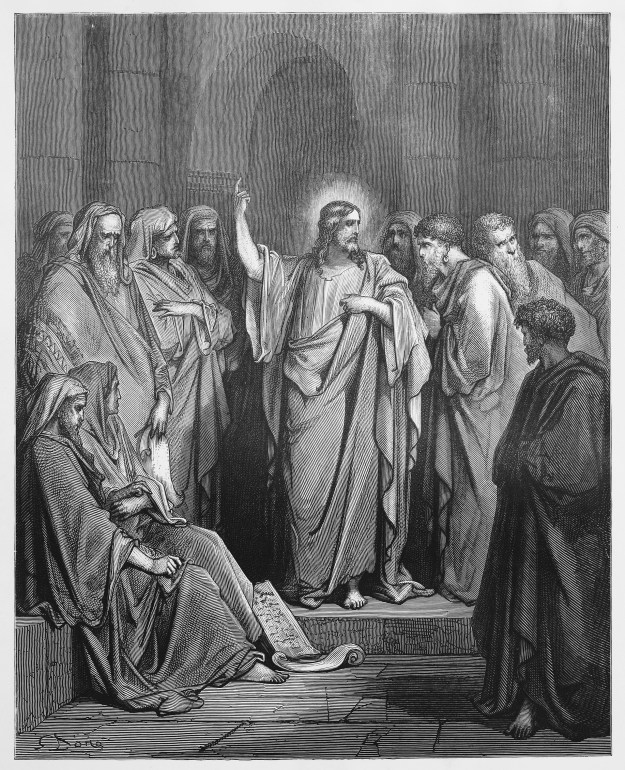 In Luke 4:14-21; Luke says, “Jesus returned to Galilee in the power of the Spirit, and news about him spread through the whole countryside. He was teaching in their synagogues, and everyone praised him. He went to Nazareth, where he had been brought up, and on the Sabbath day he went into the synagogue, as was his custom. He stood up to read, and the scroll of the prophet Isaiah was handed to him. Unrolling it, he found the place where it is written: ‘The Spirit of the Lord is on me, because He has anointed Me to proclaim good news to the poor. He has sent me to proclaim freedom for the prisoners and recovery of sight for the blind, to set the oppressed free, to proclaim the year of the Lord’s favor.’ [Isaiah 61:1-2] Then he rolled up the scroll, gave it back to the attendant and sat down. The eyes of everyone in the synagogue were fastened on him. He began by saying to them, ‘Today this scripture is fulfilled in your hearing.’ ”
 James 5:14-15, 18: 14 “Is anyone among you sick? Let him call for the elders of the church, and let them pray over him, anointing him with oil in the name of the Lord. 15 And the prayer of faith will save the sick, and the Lord will raise him up. . . .18 The effective, fervent prayer of a righteous man avails much.”
 I was inspired by a devotional I read last week (01.21.16) by Charles Stanley. He said, in part, “When we encounter opportunities to serve God, we don’t always respond in the way He desires.” Maybe “our schedule is too busy or we don’t feel qualified.” . . . “You probably never thought of a refusal to serve God as a type of idolatry, but that’s what it is—bowing down to self instead of submitting to Him.” . . . “when we’ve already decided what we can’t do, won’t do, or are ill-equipped to do, then we’re acting by our own will. That doesn’t work.” . . .”Laying down our excuses is the wisest thing to do when serving the Lord.” . . . “All He asks is that you say ‘Yes’.”



 lifevolumeone